> ## Documentation Index
> Fetch the complete documentation index at: https://mintlify.com/mlfoundations/open_clip/llms.txt
> Use this file to discover all available pages before exploring further.
# CLIP Overview
> Understanding the CLIP architecture and how it learns visual-semantic representations
# CLIP Overview
CLIP (Contrastive Language-Image Pre-training) is a neural network trained on image-text pairs that learns visual concepts from natural language supervision. OpenCLIP is an open-source implementation that enables training and using CLIP models at scale.
## Architecture
CLIP uses a **dual encoder architecture** consisting of two separate towers:
1. **Vision Encoder** - Processes images into fixed-dimensional feature vectors
2. **Text Encoder** - Processes text into the same dimensional feature space
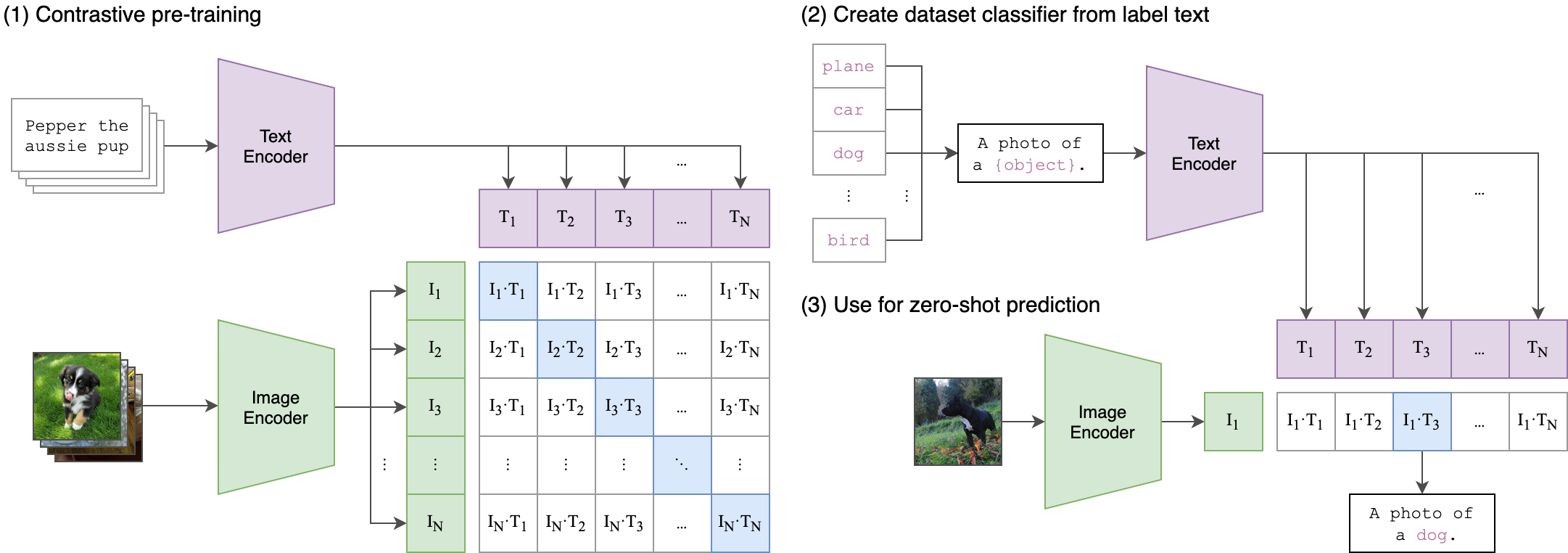 Both encoders project their inputs into a shared embedding space where semantically similar images and text are close together.
### Vision Encoder
The vision encoder transforms images into feature embeddings. OpenCLIP supports multiple vision architectures:
* **Vision Transformer (ViT)** - Default architecture, divides image into patches
* **ResNet variants** - Convolutional neural networks (ModifiedResNet)
* **ConvNeXt** - Modern convolutional architectures
* **Custom architectures** - Via timm integration
From `src/open_clip/model.py:133-206`:
```python theme={null}
def _build_vision_tower(
embed_dim: int,
vision_cfg: CLIPVisionCfg,
quick_gelu: bool = False,
cast_dtype: Optional[torch.dtype] = None
):
# Vision encoder can be ViT, ResNet, or timm model
if vision_cfg.timm_model_name:
visual = TimmModel(...)
elif isinstance(vision_cfg.layers, (tuple, list)):
visual = ModifiedResNet(...) # ResNet architecture
else:
visual = VisionTransformer(...) # ViT architecture
return visual
```
### Text Encoder
The text encoder processes text descriptions into embeddings. It uses a **Transformer architecture** with:
* Token embeddings
* Positional embeddings
* Multi-head self-attention layers
* Feed-forward networks
* Optional HuggingFace models (RoBERTa, etc.)
From `src/open_clip/model.py:209-262`:
```python theme={null}
def _build_text_tower(
embed_dim: int,
text_cfg: CLIPTextCfg,
quick_gelu: bool = False,
cast_dtype: Optional[torch.dtype] = None,
):
if text_cfg.hf_model_name:
text = HFTextEncoder(...) # HuggingFace models
else:
text = TextTransformer(...) # Native transformer
return text
```
## Contrastive Pre-training Objective
CLIP is trained using a **contrastive learning objective** that aligns image and text representations:
1. **Batch Construction** - Sample N (image, text) pairs
2. **Encoding** - Pass images through vision encoder, texts through text encoder
3. **Similarity Matrix** - Compute N×N cosine similarities between all image-text pairs
4. **Contrastive Loss** - Maximize similarity for correct pairs, minimize for incorrect pairs
The model learns to:
* Push matching image-text pairs **closer** together in embedding space
* Push non-matching pairs **further apart**
See [Contrastive Learning](/concepts/contrastive-learning) for detailed loss function explanation.
## Image-Text Similarity Scoring
Once trained, CLIP computes similarity between any image and text through:
### 1. Encode Both Modalities
```python theme={null}
# From README example
with torch.no_grad():
image_features = model.encode_image(image)
text_features = model.encode_text(text)
# Normalize to unit vectors
image_features /= image_features.norm(dim=-1, keepdim=True)
text_features /= text_features.norm(dim=-1, keepdim=True)
```
### 2. Compute Cosine Similarity
From `src/open_clip/model.py:347-354`:
```python theme={null}
def get_logits(self, image, text):
image_features = self.encode_image(image, normalize=True)
text_features = self.encode_text(text, normalize=True)
# Scaled dot product (cosine similarity with temperature)
image_logits = self.logit_scale.exp() * image_features @ text_features.T
if self.logit_bias is not None:
image_logits += self.logit_bias
return image_logits, text_logits
```
### 3. Temperature Scaling
The `logit_scale` parameter controls the sharpness of the similarity distribution:
* **Higher temperature** (lower scale) → softer, more uniform probabilities
* **Lower temperature** (higher scale) → sharper, more peaked probabilities
Initialized as: `np.log(1 / 0.07)` ≈ 2.66 (learned during training)
## Key Properties
### Joint Embedding Space
Both vision and text encoders project into the **same dimensional space** (typically 512 or 768 dimensions), enabling direct comparison.
### Zero-Shot Capability
CLIP can classify images into categories it wasn't explicitly trained on by comparing image embeddings with text embeddings of class names. See [Zero-Shot Classification](/concepts/zero-shot-classification).
### Flexibility
CLIP can be used for:
* Image classification (zero-shot or with prompts)
* Image-text retrieval
* Visual question answering
* Image captioning (with additional decoder, e.g., CoCa)
## Training in OpenCLIP
OpenCLIP supports large-scale training with:
* **Multi-GPU distributed training** - Up to 1024 GPUs tested
* **Multiple data sources** - WebDataset format for billion-scale datasets
* **Efficient batch construction** - Local loss and gradient gathering
* **Mixed precision** - FP16/BF16 for faster training
Example training command:
```bash theme={null}
torchrun --nproc_per_node 4 -m open_clip_train.main \
--train-data '/data/cc12m/cc12m-train-{0000..2175}.tar' \
--dataset-type webdataset \
--batch-size 320 \
--precision amp \
--workers 4 \
--model ViT-B-32
```
## Reference
**Original CLIP Paper:**
Radford, A., Kim, J. W., Hallacy, C., Ramesh, A., Goh, G., Agarwal, S., ... & Sutskever, I. (2021). *Learning Transferable Visual Models From Natural Language Supervision*. ICML 2021.
📄 [arXiv:2103.00020](https://arxiv.org/abs/2103.00020)
**OpenCLIP Paper:**
Cherti, M., Beaumont, R., Wightman, R., Wortsman, M., Ilharco, G., Gordon, C., ... & Jitsev, J. (2023). *Reproducible scaling laws for contrastive language-image learning*. CVPR 2023.
📄 [arXiv:2212.07143](https://arxiv.org/abs/2212.07143)
## Next Steps
Deep dive into the loss function and training objective
Learn how CLIP classifies without task-specific training
Both encoders project their inputs into a shared embedding space where semantically similar images and text are close together.
### Vision Encoder
The vision encoder transforms images into feature embeddings. OpenCLIP supports multiple vision architectures:
* **Vision Transformer (ViT)** - Default architecture, divides image into patches
* **ResNet variants** - Convolutional neural networks (ModifiedResNet)
* **ConvNeXt** - Modern convolutional architectures
* **Custom architectures** - Via timm integration
From `src/open_clip/model.py:133-206`:
```python theme={null}
def _build_vision_tower(
embed_dim: int,
vision_cfg: CLIPVisionCfg,
quick_gelu: bool = False,
cast_dtype: Optional[torch.dtype] = None
):
# Vision encoder can be ViT, ResNet, or timm model
if vision_cfg.timm_model_name:
visual = TimmModel(...)
elif isinstance(vision_cfg.layers, (tuple, list)):
visual = ModifiedResNet(...) # ResNet architecture
else:
visual = VisionTransformer(...) # ViT architecture
return visual
```
### Text Encoder
The text encoder processes text descriptions into embeddings. It uses a **Transformer architecture** with:
* Token embeddings
* Positional embeddings
* Multi-head self-attention layers
* Feed-forward networks
* Optional HuggingFace models (RoBERTa, etc.)
From `src/open_clip/model.py:209-262`:
```python theme={null}
def _build_text_tower(
embed_dim: int,
text_cfg: CLIPTextCfg,
quick_gelu: bool = False,
cast_dtype: Optional[torch.dtype] = None,
):
if text_cfg.hf_model_name:
text = HFTextEncoder(...) # HuggingFace models
else:
text = TextTransformer(...) # Native transformer
return text
```
## Contrastive Pre-training Objective
CLIP is trained using a **contrastive learning objective** that aligns image and text representations:
1. **Batch Construction** - Sample N (image, text) pairs
2. **Encoding** - Pass images through vision encoder, texts through text encoder
3. **Similarity Matrix** - Compute N×N cosine similarities between all image-text pairs
4. **Contrastive Loss** - Maximize similarity for correct pairs, minimize for incorrect pairs
The model learns to:
* Push matching image-text pairs **closer** together in embedding space
* Push non-matching pairs **further apart**
See [Contrastive Learning](/concepts/contrastive-learning) for detailed loss function explanation.
## Image-Text Similarity Scoring
Once trained, CLIP computes similarity between any image and text through:
### 1. Encode Both Modalities
```python theme={null}
# From README example
with torch.no_grad():
image_features = model.encode_image(image)
text_features = model.encode_text(text)
# Normalize to unit vectors
image_features /= image_features.norm(dim=-1, keepdim=True)
text_features /= text_features.norm(dim=-1, keepdim=True)
```
### 2. Compute Cosine Similarity
From `src/open_clip/model.py:347-354`:
```python theme={null}
def get_logits(self, image, text):
image_features = self.encode_image(image, normalize=True)
text_features = self.encode_text(text, normalize=True)
# Scaled dot product (cosine similarity with temperature)
image_logits = self.logit_scale.exp() * image_features @ text_features.T
if self.logit_bias is not None:
image_logits += self.logit_bias
return image_logits, text_logits
```
### 3. Temperature Scaling
The `logit_scale` parameter controls the sharpness of the similarity distribution:
* **Higher temperature** (lower scale) → softer, more uniform probabilities
* **Lower temperature** (higher scale) → sharper, more peaked probabilities
Initialized as: `np.log(1 / 0.07)` ≈ 2.66 (learned during training)
## Key Properties
### Joint Embedding Space
Both vision and text encoders project into the **same dimensional space** (typically 512 or 768 dimensions), enabling direct comparison.
### Zero-Shot Capability
CLIP can classify images into categories it wasn't explicitly trained on by comparing image embeddings with text embeddings of class names. See [Zero-Shot Classification](/concepts/zero-shot-classification).
### Flexibility
CLIP can be used for:
* Image classification (zero-shot or with prompts)
* Image-text retrieval
* Visual question answering
* Image captioning (with additional decoder, e.g., CoCa)
## Training in OpenCLIP
OpenCLIP supports large-scale training with:
* **Multi-GPU distributed training** - Up to 1024 GPUs tested
* **Multiple data sources** - WebDataset format for billion-scale datasets
* **Efficient batch construction** - Local loss and gradient gathering
* **Mixed precision** - FP16/BF16 for faster training
Example training command:
```bash theme={null}
torchrun --nproc_per_node 4 -m open_clip_train.main \
--train-data '/data/cc12m/cc12m-train-{0000..2175}.tar' \
--dataset-type webdataset \
--batch-size 320 \
--precision amp \
--workers 4 \
--model ViT-B-32
```
## Reference
**Original CLIP Paper:**
Radford, A., Kim, J. W., Hallacy, C., Ramesh, A., Goh, G., Agarwal, S., ... & Sutskever, I. (2021). *Learning Transferable Visual Models From Natural Language Supervision*. ICML 2021.
📄 [arXiv:2103.00020](https://arxiv.org/abs/2103.00020)
**OpenCLIP Paper:**
Cherti, M., Beaumont, R., Wightman, R., Wortsman, M., Ilharco, G., Gordon, C., ... & Jitsev, J. (2023). *Reproducible scaling laws for contrastive language-image learning*. CVPR 2023.
📄 [arXiv:2212.07143](https://arxiv.org/abs/2212.07143)
## Next Steps
Deep dive into the loss function and training objective
Learn how CLIP classifies without task-specific training